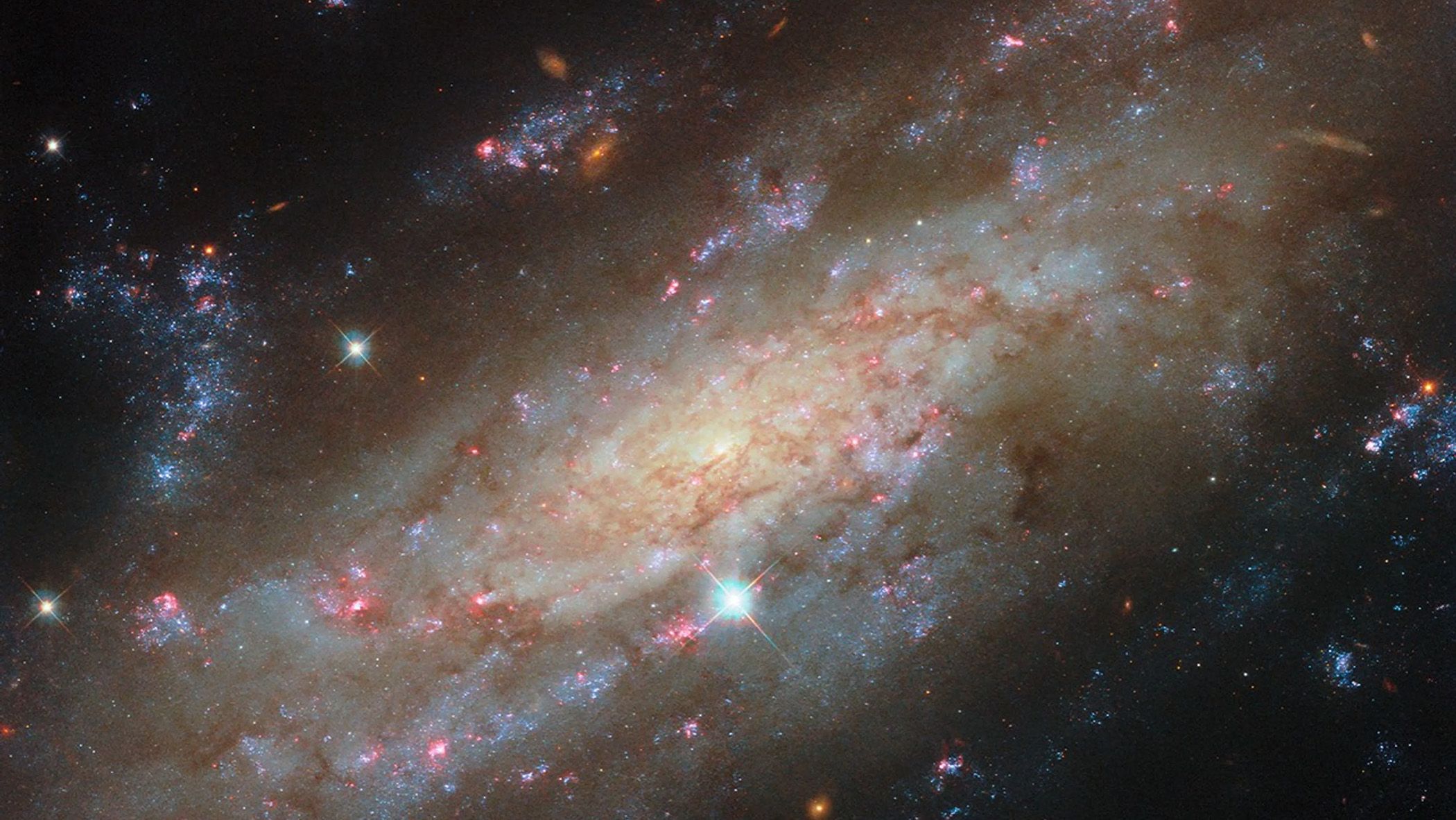
The cosmos has always been a wellspring of inspiration for photographers, and NASA's latest release from the Hubble Space Telescope is no exception. The image, featuring a nearby spiral galaxy, is a dazzling display of bright blue star clusters surrounded by glowing red gas clouds. This stunning visual not only captures the wonder of the universe but also holds valuable lessons for photographers about color, composition, and the art of capturing light—elements that can elevate terrestrial photography to celestial heights.
In this breathtaking image, Hubble has managed to encapsulate the intricate beauty of a spiral galaxy, showcasing the dynamic interplay of light and color that can be paralleled in photography. The blue clusters of stars, which are often younger and more massive, contrast sharply with the surrounding red gas clouds, which are indicative of star formation regions. The details in this photograph highlight the importance of color theory—a principle that photographers can apply when composing their shots to create striking visual narratives. Furthermore, the clarity and depth of field achieved by Hubble serve as a benchmark for photographers looking to improve their own lens techniques.
The technical specifics behind this image are as fascinating as the visual itself. The Hubble Space Telescope utilizes a range of state-of-the-art instruments, including advanced cameras like the Wide Field Camera 3 (WFC3), to capture high-resolution images across various wavelengths. The resulting data allows astronomers and photographers alike to study the structure and formation of galaxies, providing insights into the life cycle of stars. As photographers, understanding the capabilities of such equipment can inform our choices when selecting our own cameras and lenses for deep-sky astrophotography or even terrestrial landscapes.
Beyond its immediate visual appeal, this image from Hubble also situates itself within the broader context of advancements in astrophotography and space exploration. With the increasing accessibility of high-quality imaging technology, amateur astronomers and photographers are now empowered to capture stunning images of celestial events. Innovations in camera technology, such as high ISO performance and enhanced dynamic range, have made it possible for photographers to emulate the vivid colors and depth of field seen in Hubble's photographs, bringing the universe closer to home.
CuraFeed Take: This latest Hubble image is more than just a pretty picture; it represents the intersection of art and science, showcasing how technological advancements can inspire creative expression. For photographers, it serves as a reminder to push the boundaries of their craft by experimenting with color dynamics and composition, much like the Hubble team does with cosmic phenomena. As we look ahead, expect to see more collaborations between technology and photography that will continue to blur the lines between the two, offering endless opportunities for innovation and artistic exploration.